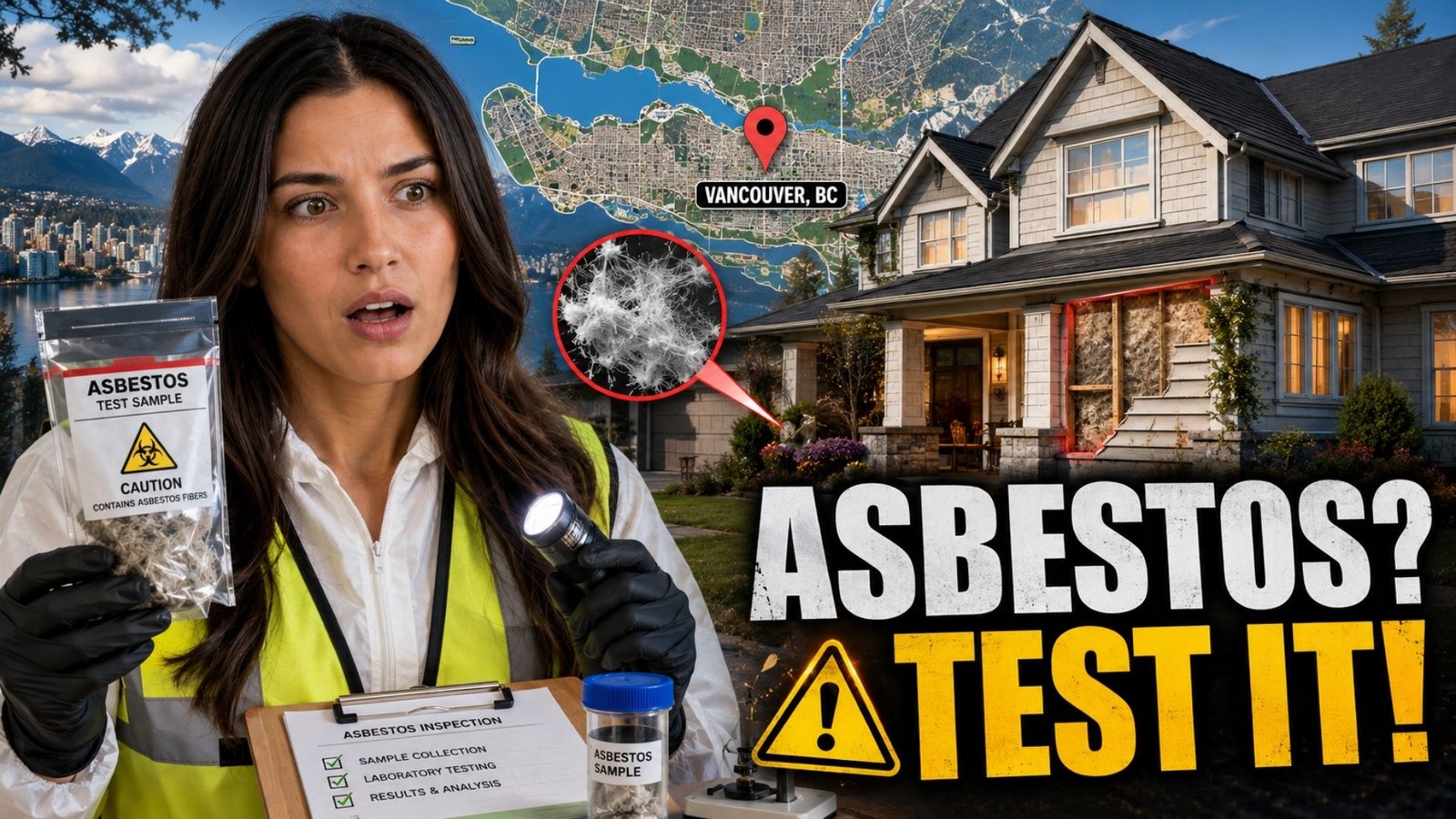
Asbestos testing in Vancouver typically costs between $270 and $1,500, depending on the number of samples collected, the size of the property, and whether a full hazmat report is required. Basic testing with 6 samples starts around $270. A full inspection with lab report runs $800–$1,500 for residential properties. Testing takes 1–2 hours on-site and 3–5 business days for lab results.
Why Asbestos Testing in Vancouver Is Not Optional
If your Vancouver home or commercial building was built before 1990, there is a real chance asbestos-containing materials (ACMs) are hiding in your walls, ceiling, floors, or pipes.
Asbestos is not dangerous when left undisturbed. But the moment those materials are cut, drilled, sanded, or demolished during renovation, microscopic fibers become airborne. Once inhaled, those fibers cannot be removed from the lungs — and the consequences can take 20–40 years to appear.
Asbestos exposure is the #1 cause of workplace fatalities in Canada, according to the Association of Workers Compensation Boards of Canada. In British Columbia specifically, WorkSafeBC has described asbestos as the province’s most serious occupational health hazard.
This guide answers every question Vancouver homeowners, landlords, and contractors ask about asbestos testing — including costs, process, BC regulations, and exactly when testing is legally required.
Who Needs Asbestos Testing in Vancouver?
Testing is recommended or legally required for anyone who:
- Owns a home or building built before 1990 in the Greater Vancouver area
- Is planning any renovation, demolition, or major repair to an older property
- Is buying or selling an older property and wants peace of mind
- Has noticed damaged insulation, crumbling ceiling texture, or deteriorating floor tiles
- Is a landlord responsible for the safety of tenants
- Is a contractor required by WorkSafeBC to identify hazardous materials before any demolition work begins
“Our technicians regularly assess homes across Metro Vancouver — from older Burnaby bungalows to heritage homes in Kitsilano — and asbestos-containing materials appear more often than most homeowners expect, particularly in properties from the 1950s to the 1980s.”
What Does Asbestos Testing in Vancouver Cost?
Here is a clear breakdown of real costs in Metro Vancouver:
| Service | Estimated Cost (CAD) |
| Basic asbestos testing (6 samples) | ~$270 |
| Additional samples (per sample) | ~$30 each |
| Standard residential inspection + samples | $250–$850 |
| Full hazmat report (testing + written report) | ~$1,100 |
| Comprehensive residential survey | $600–$1,500 |
| Commercial property survey | $2,000–$5,000 |
| Air quality / air sampling test | $300–$1,000 |
| Lab analysis per sample (accredited lab) | $25–$100 per sample |
| Expedited lab results (24–48 hrs) | Additional fee |
Factors that affect cost in Vancouver:
- Number of suspected materials to sample
- Size and age of the property
- Accessibility (attics, crawl spaces, mechanical rooms cost more)
- Whether a formal written report is needed for permits or real estate
- Turnaround time required (standard vs. expedited lab analysis)
Where Is Asbestos Found in Vancouver Homes?
Asbestos was used in over 3,000 building products from the 1950s through the early 1990s. According to WorkSafeBC, most asbestos-containing building materials in British Columbia were phased out by the early 1990s — but legacy materials remain in thousands of homes across Vancouver, Burnaby, Surrey, Richmond, and throughout Metro Vancouver.
Common Locations for Asbestos in Vancouver Homes
| Material / Location | Likely to Contain Asbestos? |
| Popcorn / textured ceiling (acoustic) | Very common — YES |
| Pipe and duct insulation | YES — especially pre-1980 |
| Drywall joint compound (“mud”) | Sometimes |
| Vinyl floor tiles and adhesive | Often |
| Vermiculite attic insulation | Yes — especially Zonolite brand |
| Cement siding (e.g., Transite) | YES |
| Roof shingles (older) | Sometimes |
| Boiler and furnace insulation | Common in older properties |
| Stipple ceiling paint | Sometimes |
| Linoleum flooring (older) | Sometimes |
Signs asbestos may be present:
- Popcorn or stipple ceiling texture
- Vintage vinyl floor tiles (9″x9″ or 12″x12″)
- Pipe wrap or duct insulation that looks grey, fibrous, or corrugated
- Vermiculite-like material in the attic
- Cement siding panels
- An older boiler, furnace, or wood stove surround
How Does Asbestos Testing in Vancouver Work?
The professional testing process follows a consistent, regulated procedure.
Step-by-Step: The Asbestos Testing Process
Step 1 — Initial Visual Assessment
A certified asbestos assessor inspects the property and identifies all suspected asbestos-containing materials (ACMs). They document each location, note the condition (intact vs. damaged/friable), and decide which samples to take.
Step 2 — Sample Collection
Using protective equipment, the technician carefully removes small material samples from each suspected location. The sampling area is sealed and decontaminated immediately after collection to prevent fiber release.
Step 3 — Laboratory Analysis
Samples are sent to an accredited laboratory. Most labs in BC use Polarized Light Microscopy (PLM) — the industry-standard method for identifying asbestos fibers and quantifying their concentration. Standard turnaround is 3–5 business days. Expedited analysis can return results in 24–48 hours.
Step 4 — Written Report
The assessor compiles results into a formal asbestos assessment report. This report identifies which materials contain asbestos, the type (e.g., chrysotile, amosite), concentration levels, and recommended next steps.
Step 5 — Recommendations
Depending on results, the report will recommend: no action required (material is intact and undisturbed), encapsulation, or full abatement/removal by a licensed contractor.
Process Flow:
Site Inspection
↓
Sample Collection
↓
Accredited Lab Analysis (PLM)
↓
Written Assessment Report
↓
Recommendations (Encapsulate / Remove / Monitor)
BC Regulations: What Vancouver Homeowners Must Know in 2024–2025
British Columbia now has some of the strictest asbestos regulations in Canada.
Key WorkSafeBC Rules (Effective January 1, 2024)
As of January 1, 2024, WorkSafeBC implemented mandatory licensing and certification requirements for all asbestos abatement work in BC. This makes BC the first province in Canada to require mandatory licensing for asbestos contractors.
What this means for you:
- All asbestos abatement contractors must hold a valid WorkSafeBC Asbestos Abatement Licence (AAL)
- Individual workers must be trained and hold a current WorkSafeBC asbestos certificate
- Building owners and prime contractors are legally required to verify a contractor’s licence before allowing any abatement work
- A Notice of Project (NOP) must be filed with WorkSafeBC before any asbestos abatement work begins
- Contractors can be subject to stop-work orders and fines for non-compliance
You can verify any contractor’s licence through the WorkSafeBC Asbestos Abatement Licence (AAL) Registry at worksafebc.com — updated daily.
Can a Homeowner Remove Asbestos Themselves in BC?
Technically, a homeowner who owns and lives in a fully detached dwelling may remove asbestos from their own home. However, this is strongly discouraged by WorkSafeBC and the Province of BC for these reasons:
- Without proper PPE and containment, fibers become airborne and can spread throughout the home
- Improper disposal of asbestos waste is a violation of BC’s Hazardous Waste Regulation
- If exposed materials are later identified during a sale or insurance claim, you may face liability
Bottom line: For anything beyond a single minor repair, hire a licensed professional.
DIY Asbestos Testing vs. Professional Testing: What’s the Difference?
| DIY Test Kit | Professional Testing | |
| Cost | $25–$100 per sample (lab only) | $270–$1,500 (full inspection) |
| Sample collection | You collect it — risk of exposure | Certified technician — safe, contained |
| Lab accreditation | Varies | Accredited BC lab (required for permits) |
| Formal report for permits | Not included | Yes — legally accepted |
| Recommended for renovation? | No | Yes — legally required |
| Risk of missed materials | High | Low |
Key takeaway: DIY kits may be acceptable for a single curiosity test. For any renovation, demolition, or permit application in Vancouver, a professional inspection with an accredited lab report is required by WorkSafeBC regulations.
Asbestos Inspection vs. Asbestos Testing: What Is the Difference?
Many Vancouver homeowners use these terms interchangeably, but they are different services.
| Asbestos Inspection | Asbestos Testing | |
| What it includes | Visual survey + sample collection | Lab analysis of collected samples |
| Performed by | Certified asbestos assessor | Accredited laboratory |
| Result | Samples + field notes | Lab report with fiber identification |
| Used for | Identifying where to test | Confirming presence/absence of asbestos |
| Necessary together? | Yes — inspection leads to testing | Yes — testing validates the inspection |
A complete asbestos assessment includes both: a professional inspection to identify and collect samples, followed by accredited laboratory testing to confirm results.
Asbestos Testing vs. Air Monitoring vs. Air Clearance: Know the Difference
| Service | When It’s Used | Purpose |
| Asbestos Testing (bulk samples) | Before renovation or demolition | Identifies ACMs in building materials |
| Air Monitoring | During abatement work | Confirms fibers don’t escape containment |
| Air Clearance Testing | After abatement is complete | Certifies the area is safe to re-occupy |
For Vancouver homeowners renovating, you typically need bulk sample testing before work begins, and air clearance testing after any confirmed asbestos has been removed.
Why Asbestos Is Still a Serious Risk in Vancouver
Vancouver has an unusually high proportion of older housing stock — particularly the East Side, South Vancouver, Kerrisdale, Dunbar, Kitsilano, and many Burnaby and Richmond neighbourhoods contain large numbers of homes built between 1940 and 1985.
According to the Occupational Cancer Research Centre, approximately 152,000 workers are currently exposed to asbestos across Canada, and occupational exposure leads to approximately 1,900 lung cancers and 430 mesotheliomas every year — amounting to 8% of all lung cancers and 81% of all mesotheliomas diagnosed annually in Canada.
The Canadian Cancer Society notes that asbestos causes lung cancer, mesothelioma, laryngeal cancer, and ovarian cancer — and that it can take decades after exposure for disease to develop. This long latency period is exactly why prevention through testing matters now.
Notably, Vancouver and British Columbia have historically seen some of the highest rates of mesothelioma in Canada, linked to past exposure in shipbuilding and construction industries.
WorkSafeBC describes asbestos as the leading cause of work-related deaths in British Columbia. Legacy asbestos in aging residential and commercial buildings remains a significant source of exposure risk every time an unsuspecting renovation disturbs undiscovered material.
Homeowner Checklist: Before You Renovate in Vancouver
Use this checklist before starting any renovation in a pre-1990 Vancouver home:
- Identify the year your home was built
- List all planned renovation areas (kitchen, bathroom, basement, attic, etc.)
- Identify any suspect materials (popcorn ceiling, old floor tiles, pipe wrap, etc.)
- Hire a WorkSafeBC-certified asbestos assessor for a professional inspection
- Collect samples and send to an accredited BC laboratory
- Receive the formal written asbestos assessment report
- If asbestos is found — hire a WorkSafeBC-licensed abatement contractor
- Verify contractor’s licence on the WorkSafeBC AAL Registry
- Ensure a Notice of Project (NOP) is filed with WorkSafeBC
- After abatement — request air clearance testing before resuming work
- Obtain final clearance report before re-occupying the space
Common Mistakes Vancouver Homeowners Make
- Assuming new-looking materials are safe
Asbestos-containing materials were sometimes painted, renovated over, or covered up. Age alone does not confirm absence. - Starting demo before testing
Even a small amount of drilling or cutting into asbestos-containing drywall can release fibers that spread through the entire home’s ventilation. - Hiring an unlicensed contractor
As of January 1, 2024, this is a legal violation in BC. If a contractor does not appear in the WorkSafeBC AAL Registry, do not hire them. - Relying on a visual inspection only
Asbestos cannot be identified by sight alone. Only accredited laboratory analysis confirms its presence. - Ignoring air clearance testing
Many homeowners skip this final step after abatement. Without an air clearance certificate, you cannot confirm the space is safe to re-occupy.
Local Context: Asbestos Testing Across Metro Vancouver
Professional asbestos testing services are available throughout the Metro Vancouver area, including:
- City of Vancouver (East Side, West Side, Downtown)
- Burnaby
- Surrey
- Richmond
- North Vancouver / West Vancouver
- Coquitlam / Port Coquitlam
- Langley / Abbotsford
- New Westminster
Important local rule: The City of Vancouver requires safe disposal of asbestos waste at approved facilities. Metro Vancouver operates accredited labs that accept residential asbestos samples. You can find accredited testing facilities at metrovancouverrecycles.org.
When working with renovation permits in the City of Vancouver or surrounding municipalities, a formal asbestos assessment report is typically required as part of the demolition permit application process.
“During a recent residential inspection in East Vancouver, our assessor identified vermiculite attic insulation and asbestos-containing floor tile adhesive in a home built in 1962. The homeowner had planned to begin a full basement renovation the following week. Early testing prevented uncontrolled fiber release during what would have been an extensive demo project.”
Expert Tips for Getting the Best Asbestos Testing Results
Tip 1 — Test before you quote.
If you are a contractor quoting a renovation project on a pre-1990 building, include asbestos testing in your pre-construction phase. Finding asbestos mid-project is far more expensive than finding it before work begins.
Tip 2 — Test all suspect materials at once.
Testing multiple materials in a single visit costs less per sample than repeat visits. Provide your assessor with a complete list of renovation areas upfront.
Tip 3 — Request an expedited lab report when timelines are tight.
Standard BC lab turnaround is 3–5 business days. If your renovation timeline is compressed, request 24–48 hour expedited analysis — it typically adds only a modest fee.
Tip 4 — Keep your assessment report on file.
Future buyers, insurers, and contractors may request evidence of asbestos assessment. A filed report protects your liability and adds transparency to real estate transactions.
Tip 5 — Verify your assessor’s credentials.
Ensure the company conducting your asbestos survey has WorkSafeBC-certified assessors and uses an accredited laboratory. Ask for lab accreditation documentation before committing.
Frequently Asked Questions: Asbestos Testing Vancouver
1. How much does asbestos testing cost in Vancouver?
Basic testing with 6 material samples costs around $270. A full residential inspection with lab analysis and a formal report typically runs $800–$1,500. Commercial surveys cost $2,000–$5,000. Individual lab sample analysis starts at $25–$100 per sample at accredited BC labs.
2. How long does asbestos testing take in Vancouver?
On-site sample collection takes 1–2 hours for a typical residential property. Lab analysis takes 3–5 business days for standard turnaround, or 24–48 hours with expedited service.
3. Is asbestos testing required before renovation in Vancouver?
Yes. WorkSafeBC requires that all asbestos-containing materials be identified before any renovation, repair, or demolition work that could disturb them. Contractors are legally obligated to conduct a hazardous materials survey before demolition begins.
4. Can I test for asbestos myself in Vancouver?
You can purchase a DIY test kit and mail samples to an accredited lab. However, collecting samples without proper protective equipment carries health risks. DIY results are also generally not accepted for permits or contractor insurance purposes. A professional inspection is strongly recommended.
5. What happens if asbestos is found in my Vancouver home?
If asbestos is confirmed, you have several options: leave it undisturbed (if it is in good condition and not being renovated), encapsulate it (seal it to prevent fiber release), or have it removed by a WorkSafeBC-licensed abatement contractor. Your assessment report will specify which action is appropriate.
6. Do I need asbestos testing to sell my Vancouver home?
It is not always legally required, but testing before listing is increasingly expected by buyers and their inspectors, especially for pre-1990 homes. Undisclosed asbestos discovered after sale can lead to legal disputes. Proactive testing protects sellers and simplifies the transaction.
7. Is it safe to live in a home with asbestos?
Yes — asbestos-containing materials that are in good condition and left undisturbed do not pose an immediate risk. The danger occurs when materials are damaged, deteriorating, or disturbed during construction. If you suspect damaged ACMs, contact a certified assessor before attempting any repair.
8. What types of asbestos are found in Vancouver homes?
The most common type found in BC residential buildings is chrysotile (white asbestos), which was used in the majority of building products. Other types including amosite (brown) and crocidolite (blue) may appear in commercial or industrial buildings. All forms are regulated under WorkSafeBC guidelines.
9. How do I find a licensed asbestos contractor in Vancouver?
Check the WorkSafeBC Asbestos Abatement Licence (AAL) Registry at worksafebc.com. This free, publicly searchable online database is updated daily and lists all currently licensed asbestos abatement employers across BC.
10. What is a Notice of Project (NOP) and do I need one?
A Notice of Project is a formal notification filed with WorkSafeBC before any asbestos abatement work begins. Your licensed contractor is responsible for filing it. Failure to file can result in stop-work orders and fines.
11. What is air clearance testing and is it required?
Air clearance testing is conducted after asbestos removal is complete. An independent assessor measures fiber levels in the air to confirm they fall within safe limits. It is required before the space can be legally re-occupied after abatement.
12. Does asbestos testing hurt property value in Vancouver?
No — in fact, a clean asbestos test report or a documented abatement history typically protects and can enhance property value. Buyers, lenders, and insurers prefer documented certainty over unknown risk.
13. How old does a building have to be to need asbestos testing in BC?
WorkSafeBC guidance focuses on buildings constructed before the early 1990s. While most asbestos products were phased out by that point, some materials remained available into the mid-1990s. When in doubt, test.
14. Is vermiculite insulation in my Vancouver attic dangerous?
Vermiculite attic insulation — particularly the Zonolite brand — is associated with high contamination by asbestos. Health Canada strongly recommends that homeowners with vermiculite insulation treat it as if it contains asbestos and not disturb it without professional assessment.
15. Can asbestos testing be done in winter in Vancouver?
Yes. Asbestos testing is an indoor service and can be conducted year-round regardless of weather conditions.
Conclusion: Don’t Renovate Until You Know What’s in Your Walls
If your Vancouver home or building was built before 1990, asbestos testing is not a luxury — it is a necessary first step before any renovation, demolition, or sale.
Key takeaways:
- Asbestos testing in Vancouver costs $270–$1,500 depending on scope
- Lab results take 3–5 days (or 24–48 hours expedited)
- As of January 1, 2024, all asbestos abatement in BC must be performed by WorkSafeBC-licensed contractors
- Testing before renovation protects your health, meets legal requirements, and prevents costly mid-project surprises
The good news: testing is straightforward, affordable relative to the risk, and widely available across Metro Vancouver. A single professional inspection can give you the certainty you need to move forward safely.
Next step: Contact a WorkSafeBC-certified asbestos assessor to schedule an inspection before your renovation begins. Verify any abatement contractor’s licence at the WorkSafeBC AAL Registry before hiring.
Official Sources & References
- WorkSafeBC — Asbestos
- WorkSafeBC — Asbestos Abatement Licence Registry
- WorkSafeBC — Licensing and Certification Requirements (2024)
- Province of BC — Managing Waste Asbestos
- Health Canada — Health Risks of Asbestos
- Occupational Cancer Research Centre — Asbestos
- CAREX Canada — Asbestos
- Canadian Cancer Society — Asbestos
- Metro Vancouver Recycling — Asbestos Testing Labs
This article is intended for informational purposes only and does not constitute legal or regulatory advice. Consult a WorkSafeBC-certified asbestos professional for guidance specific to your property and situation. CONTACT NOW